📊 Plan & schedule
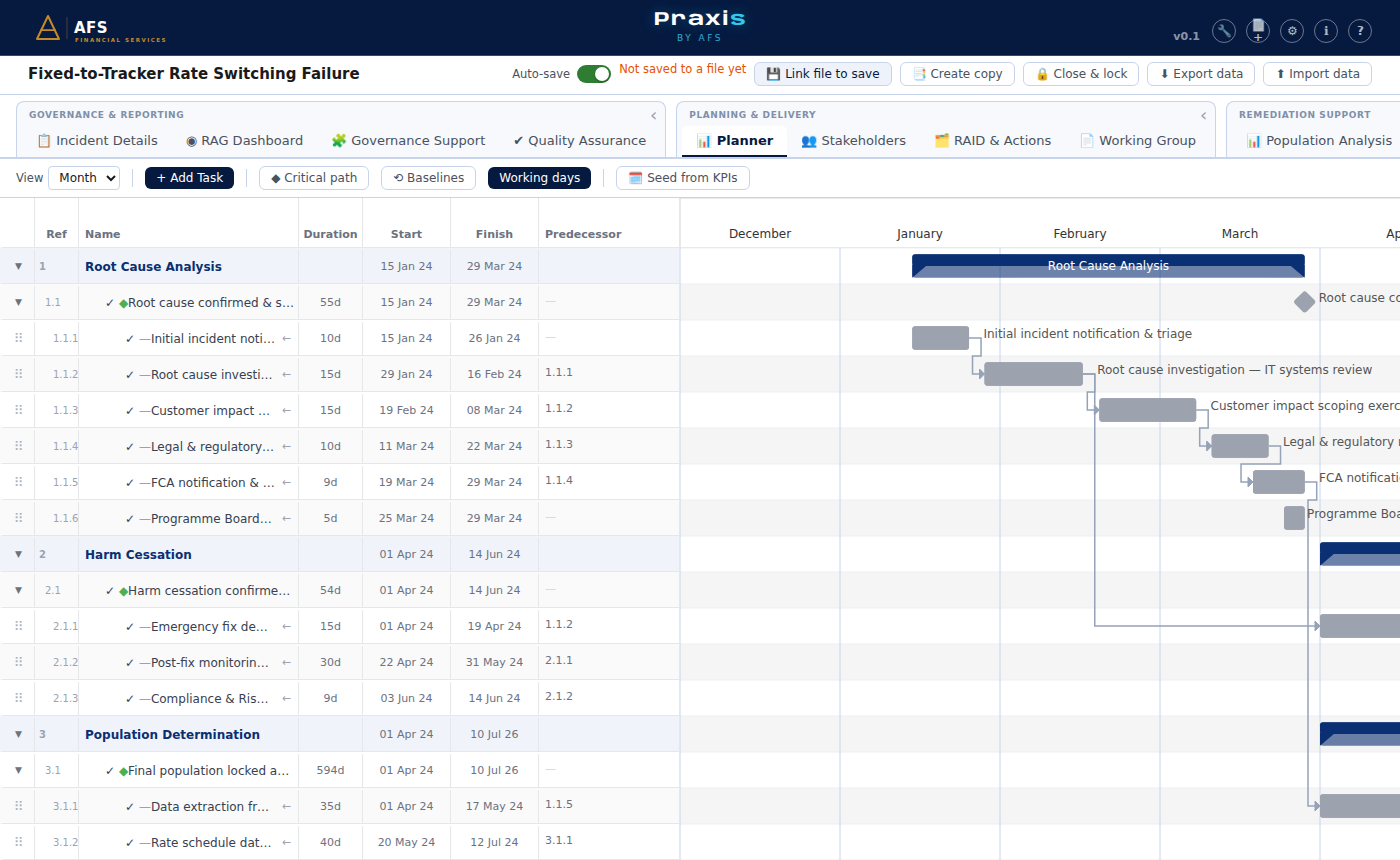
A phased delivery plan with a full Gantt: WBS references, predecessor-driven scheduling, working-day awareness, critical path, milestones with date roll-up, and reusable plan presets your PMO can mandate.
- Duration-driven tasks — set a predecessor and the dates compute
- Critical path highlighting across phases
- Preset plans: protected scaffold tasks teams can't quietly delete
🗂 RAID-E with real lifecycles
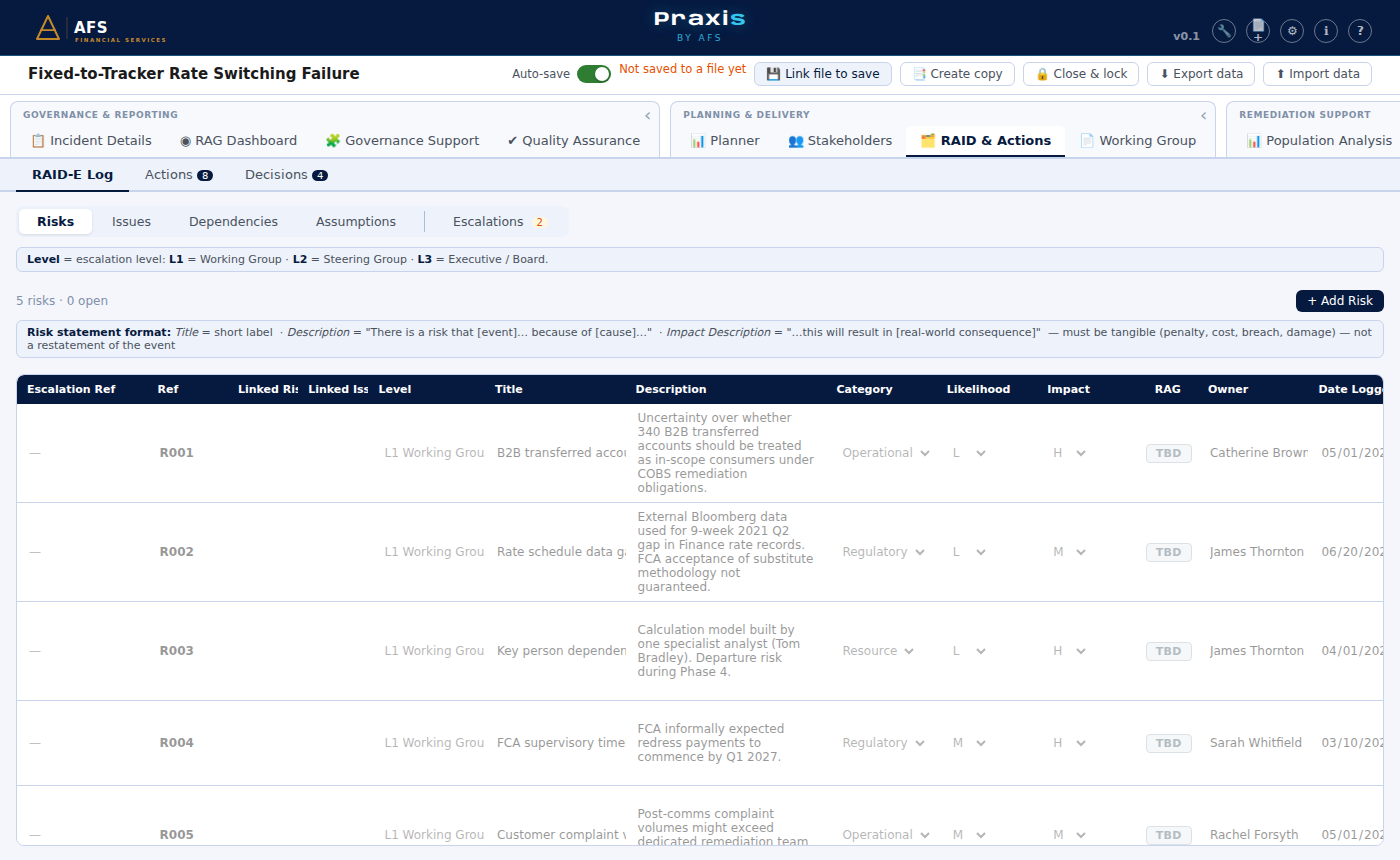
Risks, issues, dependencies, assumptions and escalations with structured lifecycles — not free-text columns. Risks promote to issues with an audit trail; closures demand a reason; escalation levels match your governance.
- Configurable likelihood × impact heatmap drives risk RAG
- Issue severity from impact × urgency — your matrix, your thresholds
- Dated updates on every item; nothing closes silently
📄 Working-group governance
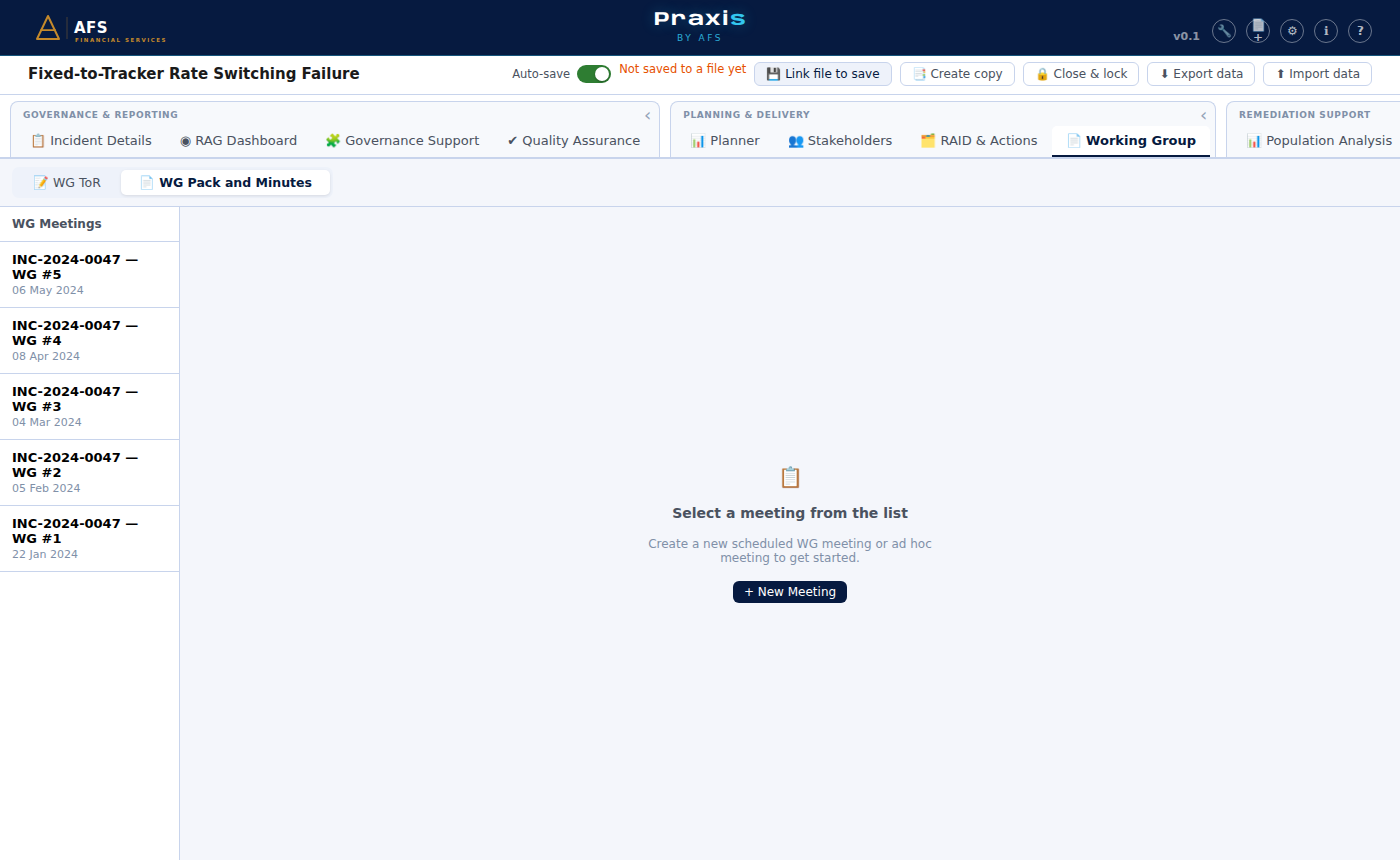
Standing agendas, meeting packs generated from live exercise data, minutes capture, and AI-assisted import: paste a Teams recap and Praxis drafts the decisions, actions, and risks for your review.
- Pack & minutes side by side, print-ready
- Terms of Reference builder with print template
- Copilot minutes import validated against your configured scales
📈 Population analysis & burndown
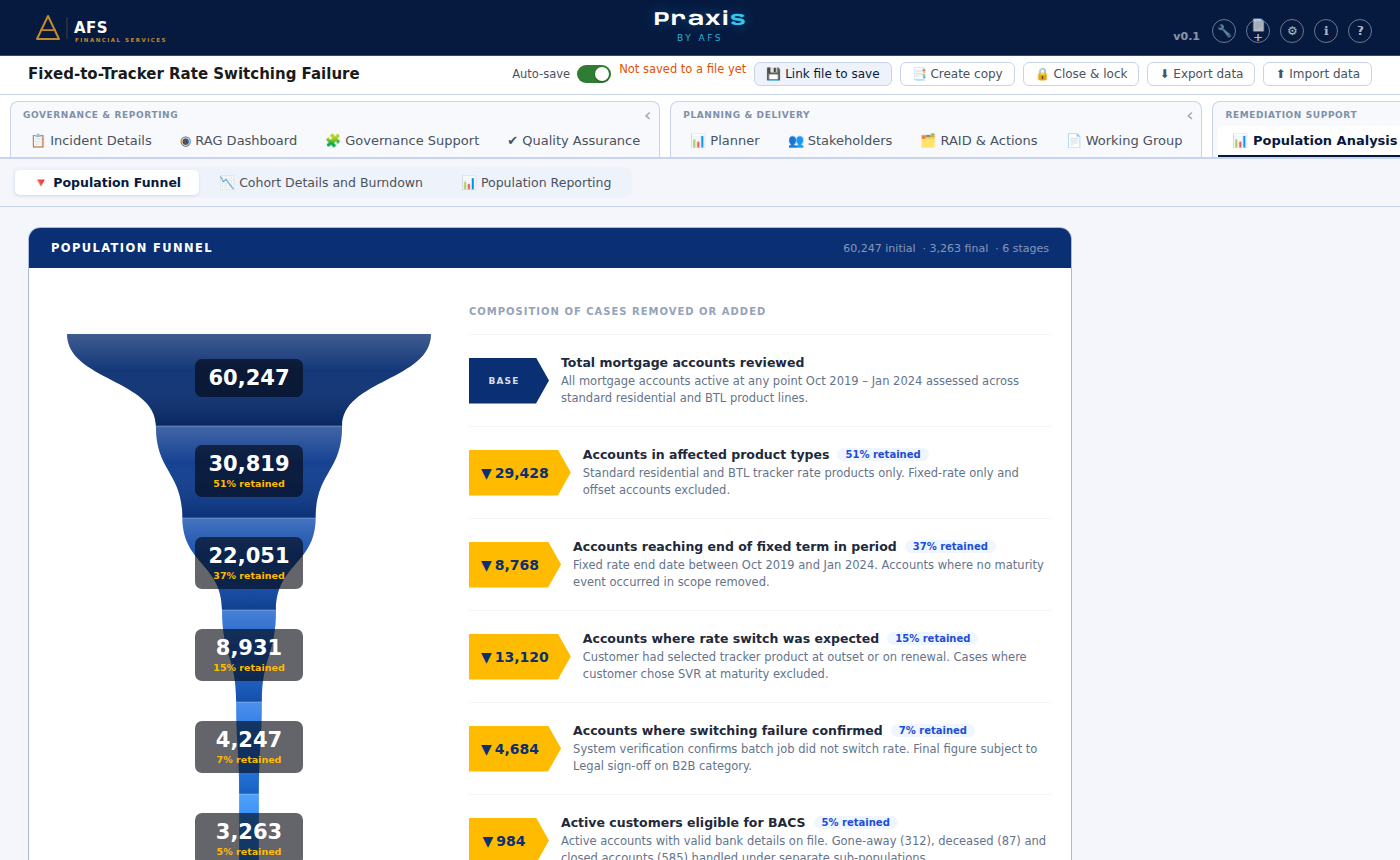
Define the affected population in industry-standard dimensions, segment it into criteria and cohorts, and track weekly burndown by volume and value — with movements (deceased, gone-away, scope changes) reconciled against baseline.
- Cohort generation by treatment combination
- Volume & value burndown with RAG and linked issues
- Filterable population report, print-ready for governance
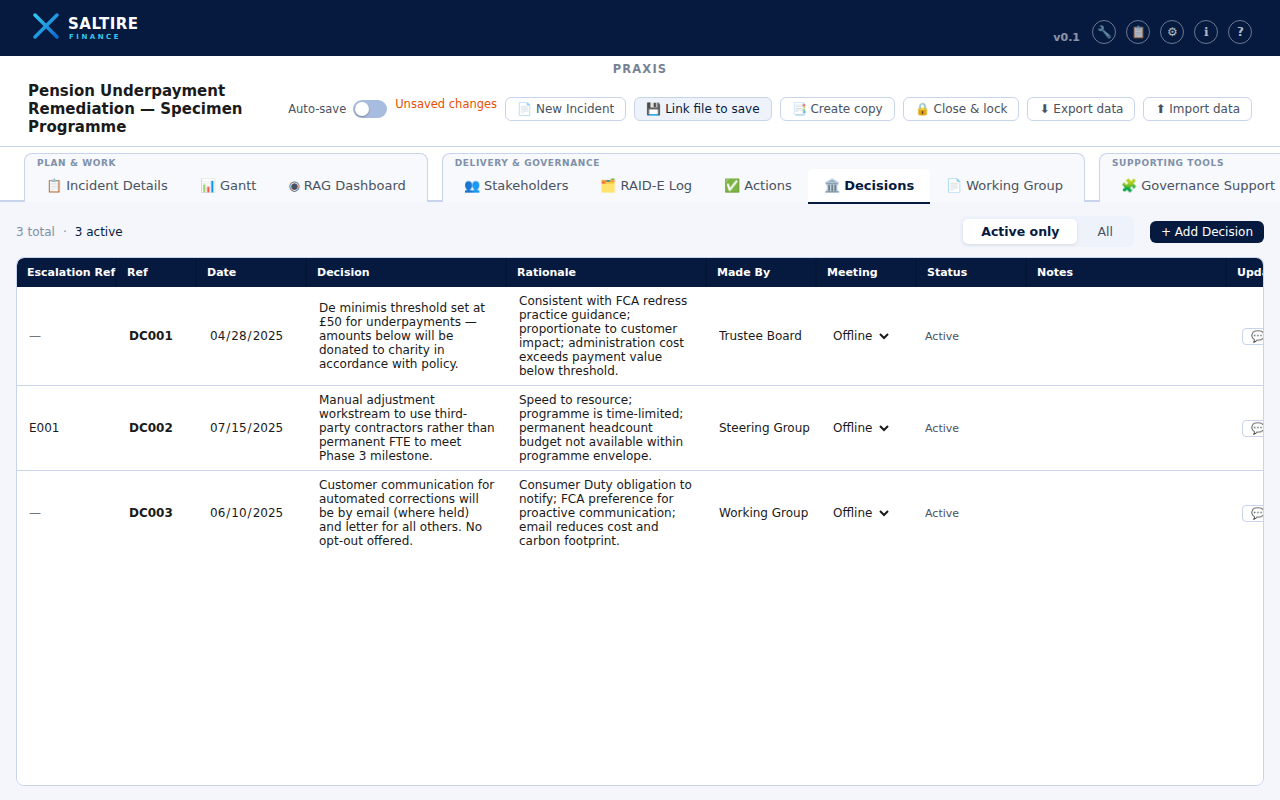
🏛 Decisions & actions that hold up
A decision log designed for scrutiny: decisions carry rationale and maker; they're superseded or reversed with reasons, never deleted. Actions carry your configured priority scale, owners, due dates, and meeting links.
- Append-only audit log across the redress exercise
- Close/reopen flows that demand a documented reason
- Exec update generator for your governance reporting
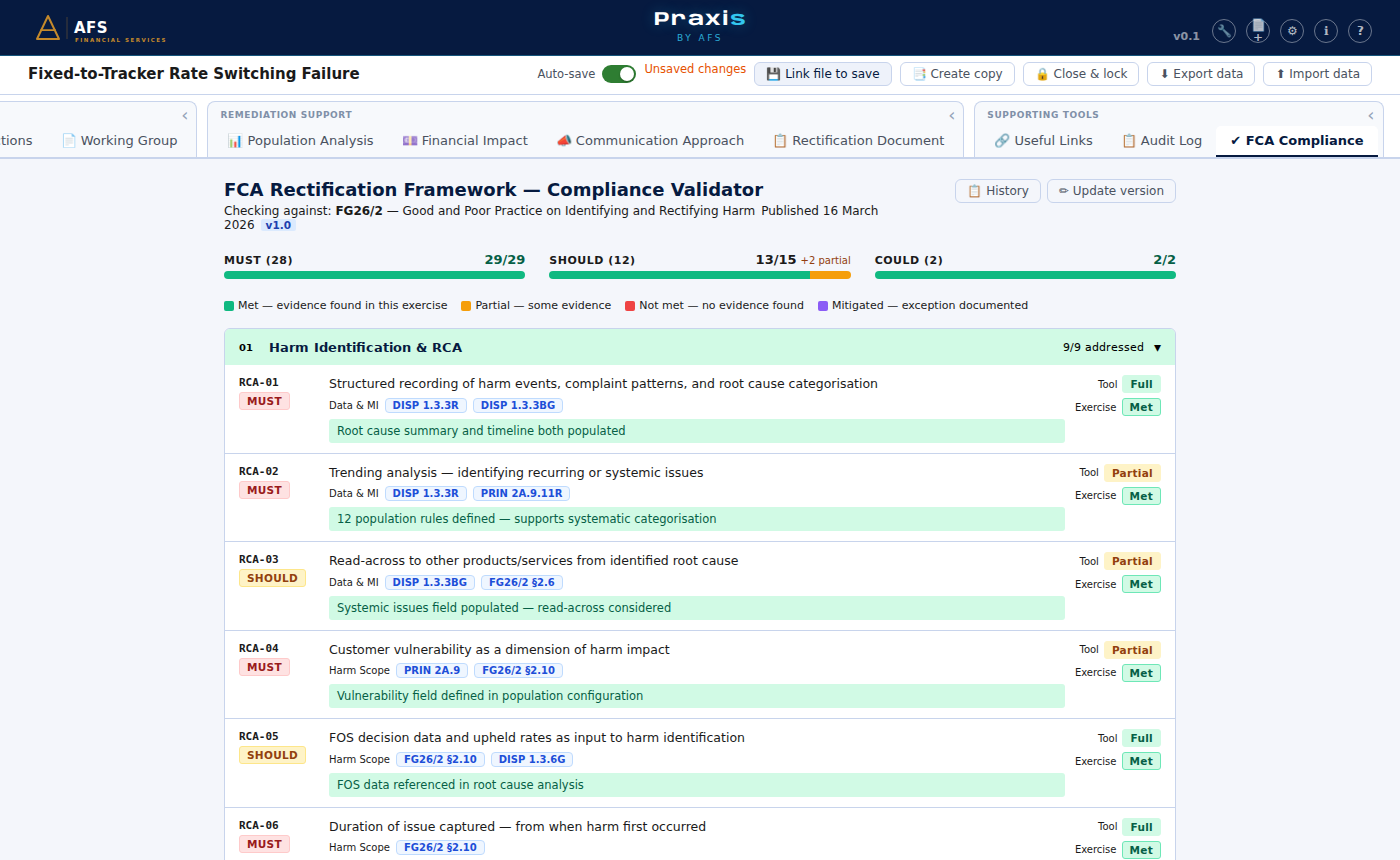
⚖️ FCA Rectification Framework Validator
Built against FCA FG26/2 and PRIN 2A.10 — 46 requirements across six phases from initial assessment to redress exercise close-out. The validator tracks every MUST, SHOULD, and COULD obligation in real time, showing evidence references, open gaps, and formally documented exceptions.
- All 46 obligations across GOV, ID, RED, CAL, MON, and CDU phases
- MUST / SHOULD / COULD gating with live compliance score
- Evidence references and documented exceptions carried into the close-out pack
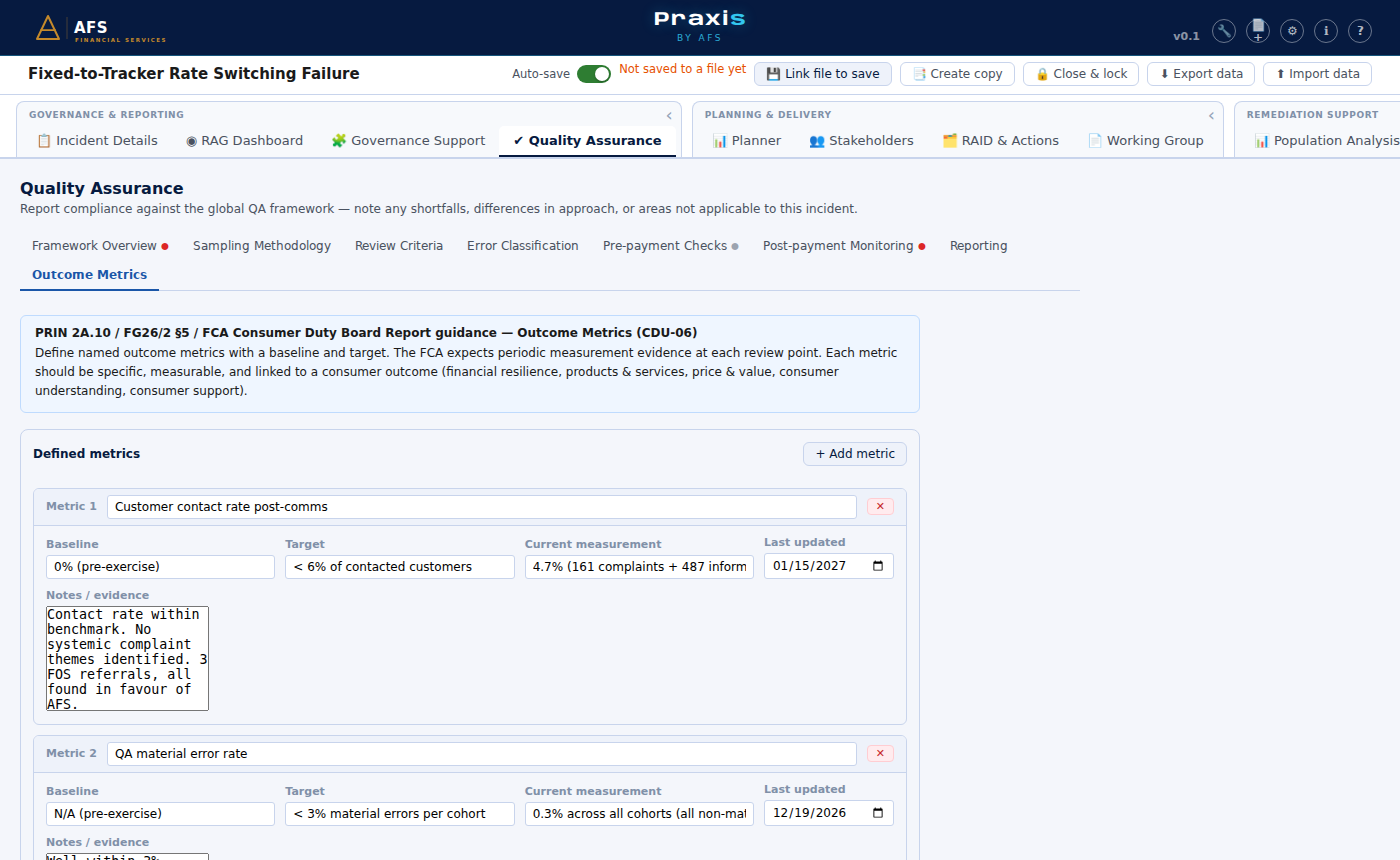
📋 Outcome monitoring & regulatory correspondence
Consumer Duty requires firms to define named outcome metrics, track them against baselines, and maintain a schedule of formal outcome reviews with evidence at each review point. Praxis structures all three — metrics, review schedule, and regulatory engagement log — against the FCA's own framework references.
- Named outcome metrics with baseline, target, and periodic measurement
- Outcome review schedule — rated findings and evidence references per checkpoint
- Regulatory engagement log: notification dates, FCA references, follow-up tracking
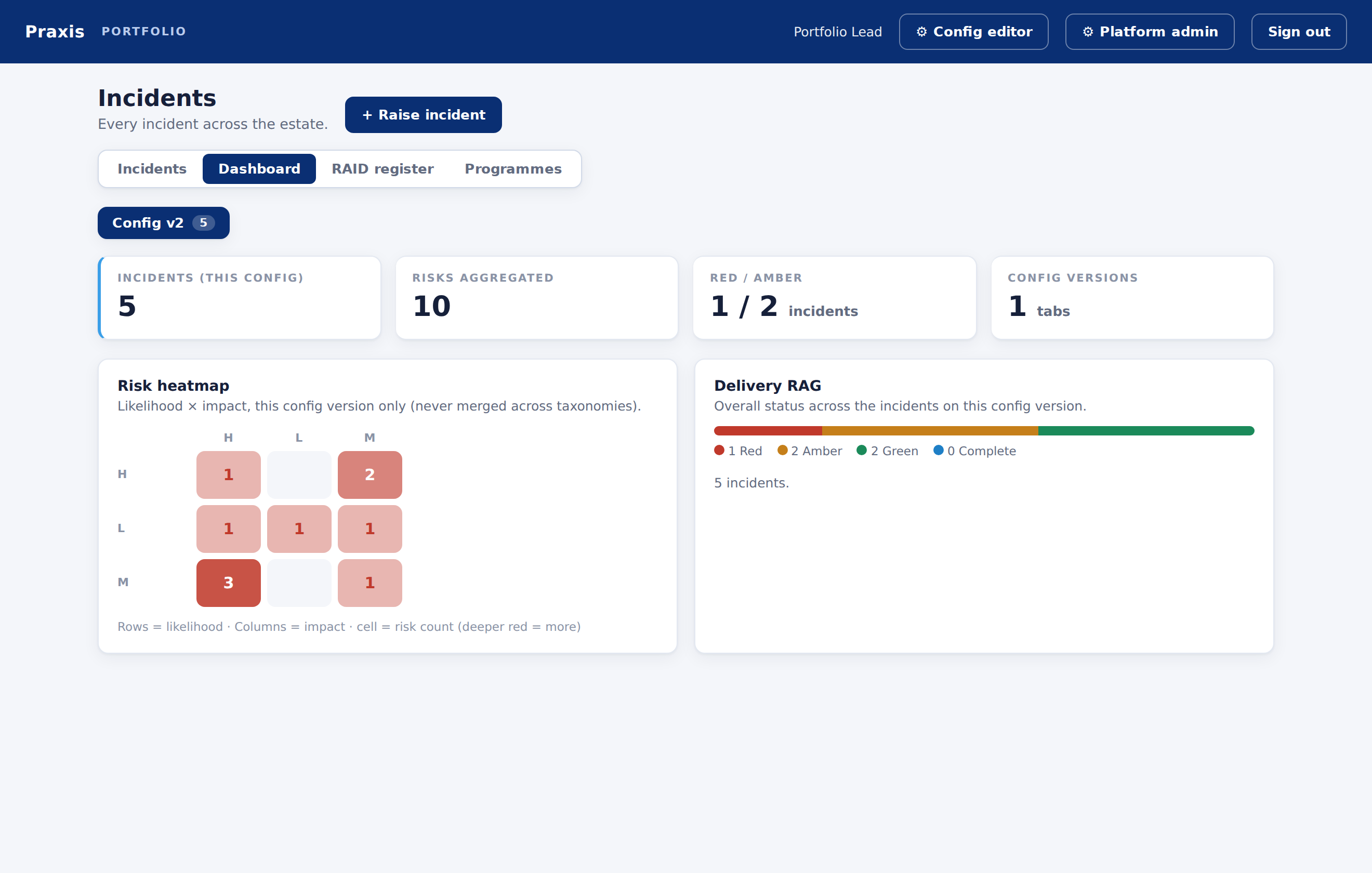
🛰 Portfolio command centre — many incidents, one governed view
Running more than one redress exercise? Praxis rolls them into a single portfolio workspace. A portfolio lead sees the whole estate — raise a new incident, assign it to a project manager, group linked incidents into programmes — while each project manager sees only the incidents assigned to them. Risk, issues and delivery aggregate upward automatically; step into any incident and back out without losing your place.
- Exec dashboard — cross-portfolio risk heatmap and roll-up tiles, live from every incident
- Portfolio RAID register — risks, assumptions, issues and dependencies across the whole estate, filtered by escalation level
- Role-aware views with per-incident scoping — a PM only ever sees, and edits, what they're assigned
- Safe concurrent editing — an optimistic version guard and write-authority hand-off stop two editors clobbering each other's work
🔐 Access & governance built for regulated firms
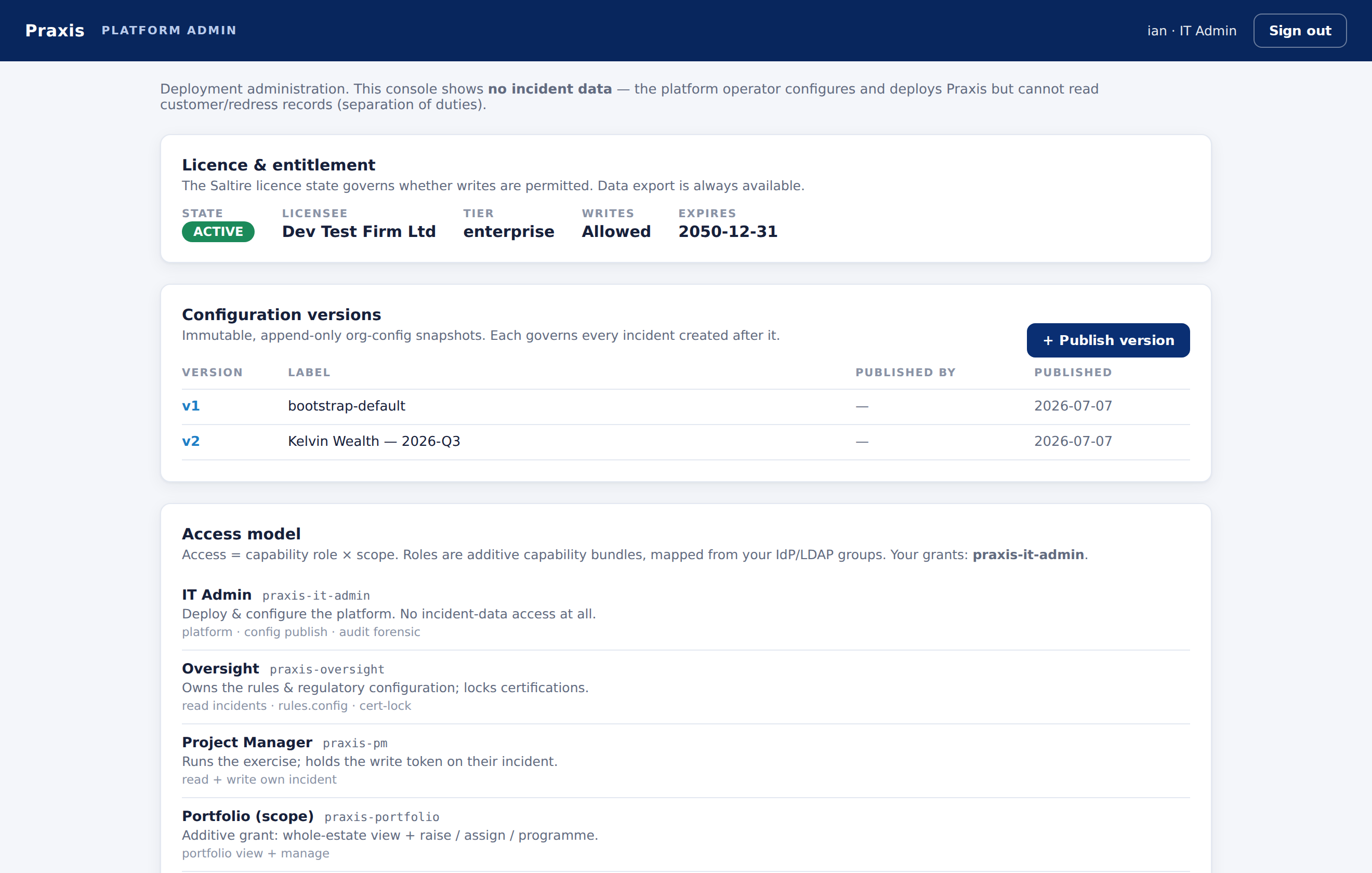
Praxis enforces least-privilege access the way a regulator expects. The operator who deploys and configures the platform can't read a single customer or redress record — separation of duties, enforced in the API, not just written in a policy. Oversight owns the rules and regulatory configuration; project managers run their exercises; you add read-only reviewers per incident for sign-off without edit rights.
- Separation of duties — the platform administrator has no access to incident data, by design
- Record-level clearance — leadership sees only escalated items across the estate; the people running an exercise see the full detail
- Versioned, immutable configuration — every incident is frozen to the config that applied when it ran, so you can always show which rules governed an exercise
- Per-incident roles — assign editors and read-only reviewers; a person can run one exercise and only review another
🔒 Deployment your security team will approve
However you run it, your data stays in your environment and never reaches us. Start as a single self-contained file — runs in the browser you already approve, saves to the file shares you already govern, no network calls, nothing to install or host. Or deploy it as a governed intranet application when you need multi-user access and a portfolio view. Both keep every byte in-house.
- Single-file mode: works fully offline — no server, no cloud, no telemetry
- Intranet mode: client-hosted in your own environment — Saltire has zero access by design
- Recovery snapshots, session locking, and white-label template export for firm-wide rollout
intranet — your data
never leaves your estate.